
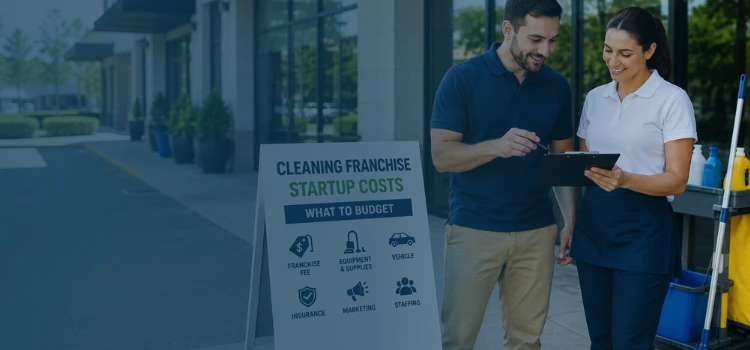
A cleaning franchise can appeal to entrepreneurs who want a service business without the inventory, kitchen buildout, or large retail footprint required by many other franchise concepts. Demand can come from homeowners, offices, medical facilities, retail locations, property managers, and other organizations that need recurring cleaning services.
Still, entering the industry requires more than paying for the right to use a franchise brand. A new owner may need to fund equipment, transportation, insurance, hiring, marketing, software, supplies, and several months of operating expenses before the business develops steady revenue.
The actual cleaning franchise startup cost depends heavily on the franchise system, market, territory, service model, staffing plan, and equipment requirements. Understanding those variables before signing an agreement can make the financial decision much clearer.
What Should You Budget to Launch a Cleaning Franchise?
There is no single investment figure that accurately represents every cleaning franchise. A small residential concept operated from home may have a very different financial profile from a commercial cleaning franchise managing multiple crews and vehicles.
It also helps to separate launch investment from recurring operating expenses. Launch investment covers what is required to get the business ready to operate. Recurring costs include expenses such as wages, royalties, advertising contributions, fuel, insurance, and cleaning materials.
Prospective franchisees should use the franchisor's Franchise Disclosure Document, especially the sections covering fees and estimated initial investment, when evaluating a specific opportunity.
Common Expenses When Opening a Cleaning Franchise
Startup planning commonly includes the franchise payment, equipment, initial supplies, transportation, insurance, licensing, marketing, technology, employee onboarding, office expenses, professional services, and a cash reserve.
Cleaning Franchise Investment Breakdown
Startup Expense | What It Typically Includes |
|---|---|
Franchise Payment | Upfront payment for entry into the franchise system |
Equipment & Supplies | Machines, tools, chemicals, and initial materials |
Transportation | Vehicles or other transportation needed for crews and equipment |
Insurance | Coverage required to protect the business and employees |
Licensing & Registration | Government registrations, permits, and local requirements |
Launch Marketing | Advertising and promotional activity used to attract early customers |
Technology | Scheduling tools, software, computers, phones, and business systems |
Training | Initial education for the owner and, where applicable, employees |
Administrative Setup | Home-office or commercial workspace expenses |
Operating Reserve | Funds available to support the business while sales are building |
Understanding the Upfront Franchise Payment
The initial franchise payment gives the franchisee the contractual right to operate under the franchisor's system and brand for the agreed territory and term.
The amount varies because franchise companies differ in brand recognition, training programs, technology, territory structure, support, and operating resources.
What Can the Initial Fee Cover?
Depending on the franchise, the payment may include initial training, operating manuals, use of trademarks, startup guidance, marketing materials, territory rights, and access to proprietary business systems.
It should not be assumed that every startup expense is covered. Equipment, insurance, vehicles, licenses, and working capital are often separate.
Can You Get the Franchise Payment Back?
Refund policies depend on the specific agreement. Some payments may become nonrefundable once the agreement is executed or certain services have been delivered.
Before transferring funds, review the applicable FDD provisions, the franchise contract, and any refund language with appropriate professional advisers.
Equipment and Cleaning Supplies Costs
Equipment requirements depend on what customers the franchise serves and which services it offers.
A new operation may need commercial vacuums, floor-care tools, chemicals, buckets, mops, protective gear, storage containers, uniforms, and replacement supplies.
Does Every Cleaning Franchise Need Specialized Equipment?
No. A residential cleaning franchise may rely on relatively standard cleaning tools, while carpet cleaning, floor restoration, commercial janitorial services, or specialty sanitation may require larger or more expensive equipment.
Franchisees should also consider replacement cycles and maintenance instead of budgeting only for the first purchase.
Vehicle and Transportation Expenses
Transportation can become an important operating cost when employees travel between multiple client locations.
Depending on the model, the franchise may require purchasing or leasing a vehicle. Additional expenses can include branded graphics, fuel, repairs, preventive maintenance, registration, and commercial auto coverage.
Territory size matters here. A business serving a wider geographic area can face significantly higher mileage and fuel costs than a densely concentrated operation.
Insurance, Business Registration, and Permits
A cleaning company may require several types of protection and registration before operating.
Possible requirements include general liability coverage, workers' compensation, commercial vehicle insurance, state business registration, local licensing, and permits connected with particular services.
These obligations are not identical everywhere. Owners should confirm the current rules in the state, county, and municipality where their franchise will operate.
Marketing and Customer Acquisition Costs
Even when the franchisor has an established name, customers still need to discover the local franchise.
Early marketing expenses may include local SEO, digital ads, social media, printed materials, neighborhood promotions, networking, a local website or landing page, and opening campaigns.
Launch Marketing Compared With Recurring Marketing
Launch spending is designed to create early awareness and generate the first group of customers. Ongoing marketing supports continued lead generation and customer retention.
Some franchise agreements also require franchisees to pay into system-wide marketing programs while maintaining a separate budget for local customer acquisition.
Employee Recruitment and Training Costs
Labor deserves careful attention because many cleaning businesses depend heavily on employees to deliver services.
Possible costs include job advertising, recruiting, background screening, onboarding, training, uniforms, wages, payroll taxes, benefits, and workers' compensation.
Why Staffing Changes Your Startup Budget
A franchise owner who performs much of the work personally may begin with lower labor expenses. A multi-crew operation, however, may need employees on payroll before the customer base is large enough to support those wages.
This early mismatch between payroll obligations and incoming revenue can tighten the business's available cash during its launch period.
Working Capital for a Cleaning Franchise
Working capital is the money available to cover normal obligations while the franchise builds its customer base.
Revenue rarely becomes perfectly predictable from the first week. Meanwhile, employees need to be paid and bills continue arriving.
A working-capital plan may need to cover:
Payroll
Insurance
Cleaning materials
Fuel
Advertising
Rent
Software subscriptions
Debt payments
Administrative expenses
Unplanned repairs or other unexpected costs
Building the Right Operating Reserve
Rather than choosing a standard reserve amount, franchisees should build a cash-flow forecast around their specific business.
Consider expected customer growth, payroll timing, staffing plans, customer payment terms, debt obligations, local costs, and the estimated period required to reach a stable operating level.
Recurring Expenses After the Franchise Opens
Starting the business is only the first financial step. Owners also need to understand the costs that continue each month.
Franchise Royalties
These are recurring payments to the franchisor and may be calculated according to revenue or another formula stated in the agreement.
Brand and Local Advertising
Ongoing costs can include required marketing contributions as well as money spent within the local territory.
Labor
As the customer base grows, wages, payroll taxes, recruiting, and employee-related costs can become a major portion of total expenses.
Supplies and Materials
Chemicals, disposable items, protective equipment, and cleaning tools must continually be replenished.
Insurance
Premiums may change as the company adds workers, vehicles, customers, or additional services.
Transportation
Fuel, vehicle payments, maintenance, and repairs continue long after opening.
Business Technology
Scheduling systems, CRM platforms, accounting software, payroll services, communication tools, and other subscriptions can create recurring monthly costs.
Administration
Bookkeeping, office supplies, banking charges, professional services, and workspace costs should also be included in the operating budget.
Franchise Cleaning Business vs. Building Your Own Cleaning Company
Factor | Cleaning Franchise | Independent Company |
|---|---|---|
Brand | Operates under an existing name | Creates its own identity |
Upfront Franchise Payment | Required | Not applicable |
Operating Processes | Usually supplied | Must be developed internally |
Training | Commonly included | Owner must create or source training |
Marketing | Franchise resources plus local efforts | Entirely owner-managed |
Royalties | Common | None |
Operating Freedom | Subject to franchise standards | Greater independence |
Business Support | Franchisor resources available | Owner builds support network independently |
An independent company may avoid franchise-related payments, but that does not automatically make it the financially stronger option.
Independent owners must develop their own systems, processes, marketing approach, training materials, and brand. A proper comparison should consider the total cost of ownership and the potential economics of each model.
Ways to Finance a Cleaning Franchise
Several funding approaches may be available depending on the franchisee's financial position and the franchise concept.
Personal Capital
Using savings can reduce borrowing costs but concentrates more of the owner's money in the business.
SBA-Backed Loans
Some qualified franchise investments may be eligible for loans offered by participating lenders under SBA programs.
Traditional Business Lending
Banks and commercial lenders may provide financing based on factors such as creditworthiness, collateral, business projections, and borrower experience.
Equipment Financing
Vehicles or expensive cleaning machinery may be financed separately rather than paid for entirely upfront.
Retirement Funding Structures
Certain financing structures can use eligible retirement assets to fund a business. These arrangements involve specific tax, legal, and compliance requirements, so investors should review the structure carefully with qualified advisers before moving forward.
Financing Connected to the Franchise System
Certain franchisors maintain relationships with financing providers or offer funding arrangements for qualifying franchisees.
Before taking on debt, calculate the monthly payments, borrowing costs, repayment period, and impact those obligations may have on early cash flow.
What Causes Cleaning Franchise Costs to Vary?
The required investment can change substantially based on several factors.
Franchise Brand
Established systems can have different fees, requirements, and operating standards.
Location
Wages, insurance, licensing, transportation, and rent differ between markets.
Territory
A larger service area can require more marketing, vehicles, employees, and travel.
Residential or Commercial Model
Residential, commercial, janitorial, and specialty cleaning businesses can operate very differently.
Staffing Strategy
Launching with several teams requires more recruiting and payroll funding.
Equipment
Specialized cleaning services generally require greater equipment investment.
Transportation
Vehicle requirements can significantly affect both startup and monthly expenses.
Workspace
Some owners operate from home, while others require administrative or storage facilities.
Local Wage Rates
Higher compensation requirements can quickly affect the franchise's cost structure and break-even level.
How to Review a Cleaning Franchise Before Investing
A sound franchise analysis should look beyond the advertised entry price.
Study the Franchise Disclosure Document
Review the fees, estimated investment, obligations, territory terms, franchise system information, and other relevant disclosures.
Build a Complete Startup Budget
Combine the franchise-related payments with equipment, staffing, transportation, insurance, marketing, and cash reserves.
Forecast Monthly Expenses
Estimate what the business will actually cost to operate after opening.
Model Realistic Sales Scenarios
Consider customer volume, pricing, contract size, capacity, and territory rather than relying on optimistic assumptions.
Determine the Break-Even Sales Level
Calculate how much monthly revenue is needed for the business to cover its cost structure.
Test the Cash Position
A profitable month can still create financial strain when customer payments arrive later than payroll, loan installments, or supplier bills.
Understand Royalties and Other Franchise Charges
Evaluate how recurring payments affect the amount of revenue ultimately retained by the business.
Compare Other Opportunities
Consider alternative franchise concepts and independent ownership before making a final investment decision.
When Might a Cleaning Franchise Reach Break-Even?
Profitability depends on how quickly the franchise generates enough business to cover its operating costs.
Compare Sales With the Cost of Delivering Service
Growing sales will not necessarily improve profitability if labor, transportation, or service-delivery costs grow just as quickly.
Evaluate Gross Profitability
Review what remains from sales after the direct expenses associated with performing cleaning services have been deducted.
Evaluate Bottom-Line Profitability
Then account for overhead, royalties, marketing, administration, insurance, financing costs, and other operating expenses.
Find the Break-Even Revenue Level
The break-even calculation identifies the sales level at which the operation's income covers its expenses without producing either a profit or loss.
What Can Speed Up or Delay Profitability?
Important variables include customer acquisition, pricing, employee productivity, local competition, recurring contracts, client retention, territory design, labor rates, and operational efficiency.
Common Cleaning Franchise Budgeting Mistakes
New franchise investors sometimes underestimate the business because they focus too heavily on the headline franchise fee.
Other common problems include budgeting too little cash for the early operating period, overlooking recruitment expenses, assuming customer growth will happen immediately, forgetting recurring franchise charges, and underfunding local marketing.
Failing to model cash flow can be particularly costly. A business may eventually become profitable but still struggle if it runs short of cash before reaching that point.
Cleaning Franchise Startup Cost Checklist
☐ Franchise entry payment
☐ Cleaning equipment
☐ Initial supply inventory
☐ Vehicle or transportation
☐ Business insurance
☐ Registration, permits, and licensing
☐ Launch marketing
☐ Technology and software
☐ Employee recruitment
☐ Initial training
☐ Payroll funding
☐ Office or administrative costs
☐ Recurring franchise charges
☐ Marketing fund contributions
☐ Working capital
☐ Contingency reserve
☐ Accounting and professional fees
How QMK Consulting Can Help You Assess a Cleaning Franchise
Before investing, the key question is not simply whether you can afford to open the franchise. You need to understand how the entire investment may perform financially once operations begin.
QMK Consulting helps franchise investors evaluate startup expenses, expected operating costs, cash requirements, break-even levels, profitability, and long-term financial performance.
Our services include franchise financial analysis, startup cost modeling, cash-flow forecasting, profitability analysis, break-even calculations, financial modeling, franchise accounting, and business advisory support.
If you are evaluating a cleaning franchise, QMK Consulting can provide a free profit and cash flow analysis to help you understand the financial picture before committing your capital. Reviewing the relationship between your expenses, expected margins, and available cash can give you stronger financial insight before deciding whether the opportunity fits your goals.
Frequently Asked Questions
What budget should I expect when opening a cleaning franchise?
The required investment depends on the franchise system, territory, location, staffing model, equipment, transportation needs, and working-capital requirements. Review the brand's FDD for its estimated investment range.
Which expenses usually have the biggest impact at startup?
Franchise-related payments, employees, equipment, vehicles, insurance, marketing, and operating reserves are commonly among the most important categories.
What determines the upfront fee charged by a cleaning franchise?
The amount varies according to the franchise system, brand, territory structure, training, technology, and level of support provided.
Is expensive equipment necessary for a cleaning franchise?
Not always. Standard residential cleaning may require relatively modest equipment, while carpet, floor-care, commercial, or specialty concepts may need larger machinery.
How should I estimate working capital?
Create a forecast based on payroll, overhead, customer payment timing, debt obligations, marketing needs, expected sales growth, and other monthly costs.
Can a cleaning franchise produce a good profit?
It can, but results depend on pricing, customer volume, employee efficiency, recurring revenue, local competition, and cost control.
What determines how quickly a cleaning franchise reaches profitability?
The timeline depends on customer acquisition, sales volume, margins, staffing expenses, debt, marketing effectiveness, client retention, and the total fixed-cost structure.
What funding options are available for a cleaning franchise?
Depending on eligibility, an investor may consider savings, traditional business lending, SBA-supported loans, equipment financing, retirement-based structures, or funding options associated with the franchise system.
Does an independent cleaning company normally cost less to launch?
It may require fewer franchise-related payments, but the owner must independently create the brand, systems, marketing strategy, training, and infrastructure. Total economics matter more than startup price alone.
Which parts of a cleaning franchise FDD deserve close financial attention?
Review the disclosures covering initial and recurring fees, estimated startup investment, franchisor obligations, territory terms, financial performance information when provided, and information about franchise openings, transfers, and closures.
Get a Franchise Financial Review
A free financial assessment covers your entity election, owner pay, and the reporting gaps most small businesses miss.
Get Your Free Financial Assessment